مقالة 2
Communism
From the womb of revolution to the arms of devil
en 31/07/2021 16:46 Mahmud El Adwi
The nucleus of anger against the ruling elite is often formed because of discrimination against a particular group of society, whether this discrimination is based on religion, race, political or social orientation, or other reasons. But usually the result is the same revolution.
But can the revolution take away more than it gives?
The answer lies only in one word communism
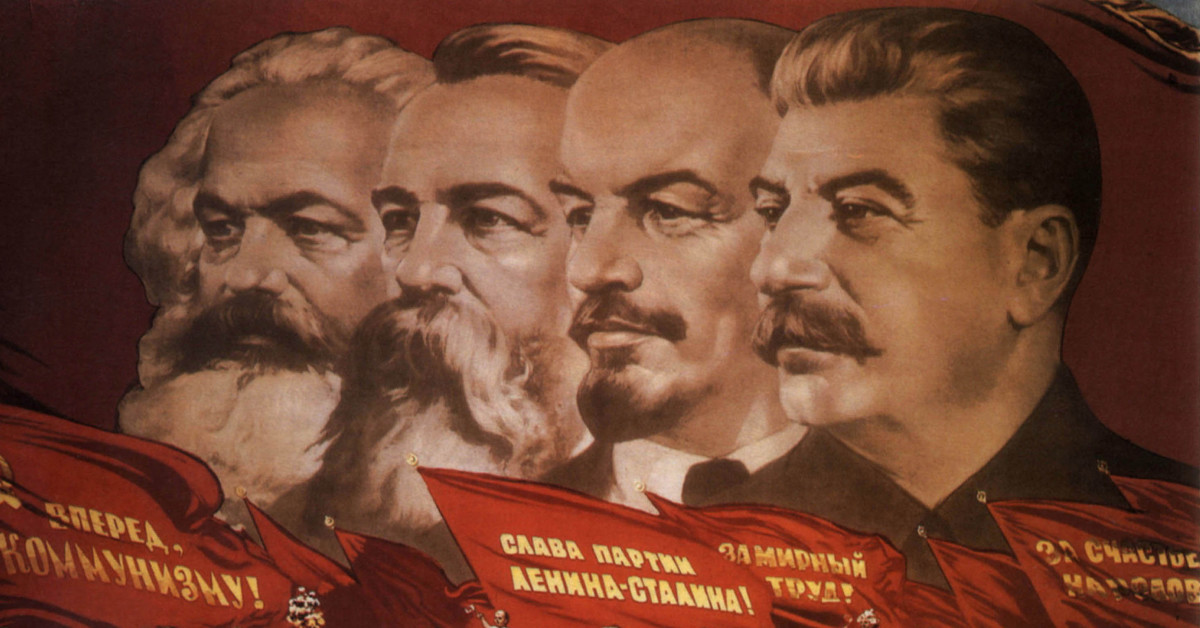
Communism as an integrated political theory dates back to the late eighteenth century by the German philosopher Karl Marx and his friend Friedrich Engels through numerous publications, the most famous of which is the Communist Party Manifesto and Capital.


The theory espoused by the godfather of communism, Vladimir Lenin who applied and developed Marx's theory after the Bolsheviks seized power in Russia in 1917. Hence the Marxist-Leninist theory adopted by the former Soviet Union.

The principles of communism as defined by Marx and Engels in the Communist Manifesto:
- Abolition of private property in land and application of all rents of land to public purposes.
- A heavy progressive or graduated income tax.
- Abolition of the rights of inheritance.
- Confiscation of the property of emigrants and rebels.
- Centralization of credit in the hands of the State, by means of a national bank with State capital and an exclusive monopoly.
- Centralization of the means of communication and transport in the hands of the State.
- Extension of factories and instruments of production owned by the State; the bringing into cultivation of wastelands, and the improvement of the soil generally in accordance with a common plan.
- Equal liability of all labor. Establishment of industrial armies, especially for agriculture.
- Combination of agriculture with manufacturing industries; gradual abolition of the distinction between town and country, by a more equitable distribution of the population over the country.
- Free education for all children in public schools. Abolition of children's factory labor in its present form. Combination of education with industrial production, etc
The actual results of the control of communist governments were nothing like Marxist theories.
As the lower class of the people who were supposed to be helped by Marxism, they were treated horribly by the government leaders.
For example: It is estimated that the leader of the Soviet Union (Joseph Stalin) killed more than 40 million people for what he called the "interest of the state".
And Stalin established (labour camps) for those who opposed the government. He even created famines in order to break the will of the people and gain complete control.
Communist countries are much less free in general. It forbids the practice of religious rites, orders some people to work in certain jobs, and prevents people from travelling or moving to other countries. People lose all property rights and government officials become unreasonably powerful.
It is also worth noting that under Mao Zedong, when he ruled China, the poverty rate was 53%. However, China began economic reforms, moving away from communism in 1978 under the leadership of Deng Xiaoping. The poverty rate fell to 6% in 2001.
British journalist and writer Daniel Hannan believes that if identity politics takes over the traditional Marxist system, it will be as repressive and intolerant as its predecessor, an inevitable result that the theorists and proponents of this thought left no room for doubt about its possibility.
And the writer asserts - in an article in the British newspaper The Telegraph - that Karl Marx may not have killed anyone with his own hands, as Adolf Hitler did not, as far as we know. But no one tried to claim that this absolved him of the atrocities unleashed by his doctrine and theories. Except for some hardened communists who claim that all the barbarism they cause is "not really real socialism".
Communism stands undisputedly at the fore in the horrific death toll. The hateful slave trade in the Atlantic, for example, claimed 10 million lives.
Communism and its supporters in all corners of the world massacred more than 100 million to this day.
-
Soviet Union
Genocide scholar Adam Jones claims that there is very little in the human experience record to match the violence unleashed between 1917, when the Bolsheviks seized power, and 1953, when Joseph Stalin died, and the Soviet Union moved to adopt a more restrictive domestic policy. He notes that the exceptions are the Khmer Rouge (in relative terms) and Mao's rule in China (in absolute terms).
Not to mention the wrong policies that almost claimed the lives of millions or the famous Chernobyl accident that could have killed the entire European continent. -
People's republic of China
The Chinese Communist Party came to power in China in 1949 after a bloody civil war between communists and nationalists. There is a general consensus among historians that after Mao Zedong seized power, his policies and political purges directly or indirectly caused the deaths of tens of millions of people. Drawing on the experience of the Soviets, Mao considered violence necessary to achieve an ideal society derived from Marxism and resolved to implement violence on a large scale.
Not mentioning the great Chinese famine 1958-1961, which have taken between 15 and 55 million souls. -
Cambodia (Democratic Kampuchea)
Killing Fields were a number of sites in Cambodia where a large number of people were murdered and buried by the Khmer Rouge regime during its rule in the country from 1975 to 1979 after the end of the Vietnam War.


Anti-communism
Anti-communist organization developed after the October Revolution of 1917 in Russia, reaching global proportions during the Cold War, when the United States and the Soviet Union engaged in intense competition. And liberalism, nationalism and social democracy, as well as anarchist or liberal and even socialist and anti-Stalinist views.
The first organization specifically dedicated to opposing communism was the Russian White Movement that fought in the Russian Civil War, beginning in 1918 against the recently established Bolshevik government, where the White Movement was militarily supported by many allied foreign governments, which represented anti-communism. Communism as government policy. With that, the Red Army defeated the White Movement, and the Soviet Union was created in 1922.
During the Soviet Union era anti-communism became an important feature, for many different political movements and governments around the world, anti-communism emerged in the United States with the First Red Terror of 1919-1920.
But the question remains. Why some parts of the society still like and support communist ? Will countries advance and develop under the communism rule one day? Will we ever be forced to choose between communism or Nazism and fascism one day?
My point of view: Extremism and intransigence always leads to horrific results. Over the years, the crimes of the extreme left and the extreme right have increased. A crime is always a crime, whether it is committed by a deranged like Hitler, a fanatical narcissist like Mussolini, or a arrogant dictator like Stalin.
Thank you for reading.
المصادر
- Wikipedia
- First They Killed My Father
- Aljazeera
- Telegraph UK